Sunday, November 29, 2015

Thanksgiving in France: As Easy As 1-2-3

Hosting a Thanksgiving party in France is nearly impossible, but we Americans do try.

First of all, it's not a national holiday here, so the dinner is usually pushed to the weekend before or after. That's not such a big deal, but there's less time to digest, watch football, and do that Christmas shopping.

Source: Duckshow.com
Second, we have to find substitutes for family. Again, this is not impossible, as there are always random Americans around without turkeys to go home to. We usually check the passports at the door.

Third, and this is the hard part, what about the turkey? Again, this is not impossible, because many a Parisian butcher has played this tune. They are very thankful for this holiday. You see, the French don't eat turkey this time of year, so a whole bird is not generally available. But if you're willing to pay double, a French butcher will sell you anything.

This year, we hosted a Thanksgiving party last night, finding only two stray Americans at our front door at the appointed time. But what guests! They brought a bird, fully cooked, flowers, and a box of chocolates.

As one of the guests unwrapped it, she told the story of the fowl's fate. A colleague has a farm, and every year offers me whatever she slaughters. “It's an organic farm, and the animals range free,” she explained. Wow, that's going to be one tasty bird, I thought.

We could nearly see the bird. “And she gives you whatever she has roaming around. You'll never know what you get.”

It looked small, the size of a chicken. “Yes, it is small,” my friend explained. “The farmer apologized, but she never knows how big they are going to be until the day she catches them.” 

Sounds like a very free range farm, I thought.

“I hope you don't mind having … duck for Thanksgiving?” she asked, as we all give it a gander. It looked naked, with its stubbly skin, as if it had just shaved. I had goosebumps. 
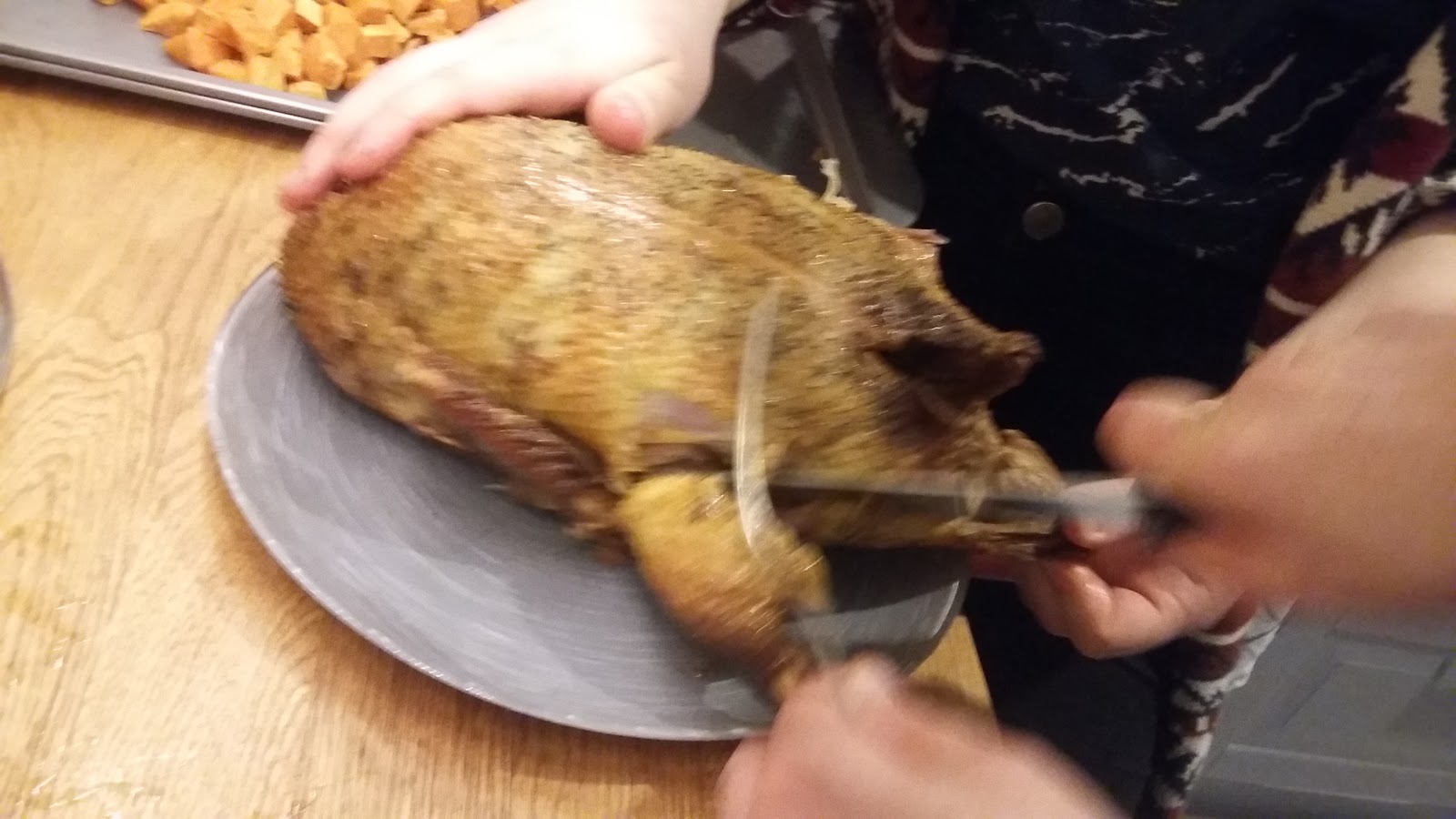
Carving the Thanksgiving duck.
So we carved the canard, and filled our plates with more of the usual Thanksgiving fare: sweet potatoes (though tossed with black beans to make a salad), a crazy cranberry sauce, and the best classic stuffing this side of the Atlantic, made better with a slab of French butter. 

We washed it down with an 8-euro Burgundy and polished it off with serial pieces of Jeff de Bruges chocolates.

How did the duck taste? Like Thanksgiving.

Rose Marie Burke, an editor and journalist, writes a blog about her personal insights into life in Paris. After 20 years in the City of Light, she still calls her native Pittsburgh "home."


Sunday, November 22, 2015

The French School System: When Will It Learn?

One thing foreign parents (like me) love about the French public school system is the focus on the three Rs: Reading, wRiting, and aRithmetic. One thing we hate …. the focus on the three Rs. To the exclusion of much else—even a child's well-being.

It's tolerable for the academic types who fit into the “mould,” as the French say. If you don't, too bad. There is almost no tolerance for physical, learning, or other disabilities. Negative reinforcement is the norm. Learning is often by rote: Teacher writes on blackboard, pupils take notes and memorize them. Don't get me wrong, there are exceptional teachers and programs.


For those pupils who don't fit in, France has some “alternative schools.” They go by the name of Montessori, Steiner, or Freinet. The country even has a few charter schools. To many Americans, these schools are the best of educational options! But many French people view them with suspicion or even derision.

In his latest book about French education, “French School Without Tears,” journalist Peter Gumbel goes into these alternative schools and reports about what's going on. (I read the paperback version in French, “Ces écoles pas comme les autres: A la rencontre des dissidents de l'éducation.)

What's shocking is that even though these schools have been generally successful over the past decades (and I mean decades), the French education system doesn't take them seriously. Many of the schools or teachers take a low profile, saying modestly, “we're not here to give the French system lessons.” When French education inspectors visit the schools, the attitude is to find out what's wrong, not what's going right. That's a shame, because study after study is showing that the traditional French system is failing.

Is the French educational system such a bad pupil, unwilling to learn and improve? Not entirely, Mr. Gumbel told me:

“So far the 'official' reaction has been largely positive. The book has been widely reviewed in the French press, and one of the reviews was published online by the Académie de Créteil. (The reviewer didn’t love the book but highlighted some points that he or she agreed with.)

“I have been invited to speak at various official conferences, including in Menton, where the city authorities invited me, and at the universities of Perpignan and Nancy, on the invitation of the education departments, as well as to numerous events in Paris. Also, Alain Juppé wrote me a nice letter. I found with my 2010 book, 'On achève bien les écoliers,' that the political parties tend to take a little longer to get their act together but hope I’ll be invited to various party conferences as I was then--the point of writing the book being to feed into the national debate about educational reform.
The French minister of education,
Najat Vallaud Belkacem

“No word yet from the cabinet of the minister, Najat Vallaud Belkacem, but I know from having talked to her before publication that she is quite ideological (i.e. anti) on the issue of alternatives.”

And Mr. Gumbel knows a bit about teaching himself, as he has taught at the prestigious Sciences Po (the equivalent of the Harvard Kennedy School of government). When he tries to engage students, foreign students tend to take the bait, working in teams and participating in discussions. “The French ones, because of the culture of their primary and secondary school system, were far more reluctant to participate,” Mr. Gumbel said.

What can French education learn from the country's own alternative schools? The author counts four best practices: 1. The best teachers regularly call into question their methods. 2. Teachers work closely together in teams. 3. Schools are run by administrations devoted to continuous improvement. 4. Teachers are concerned about the personal development of students, each of whom has a teacher who acts as tutor.

It sounds so reasonable, but is so difficult for an establishment that is used to giving lessons, not learning them.

Rose Marie Burke, an editor and journalist, writes a blog about her personal insights into life in Paris. After 20 years in the City of Light, she still calls her native Pittsburgh "home." 

Sunday, November 15, 2015

Paris Is Crying

Living out of harm's way in the south suburbs of Paris, I was spared by Friday night's terrorist attack in the eastern part of the city. Spared but deeply saddened.

The country has long been the target of terrorism. In December 1994, nine months after we arrived to live in Paris, seven were killed in the hijacking of Air France Flight 8969 by members of the Armed Islamic Group.

In July 1995, members of the same group killed eight people in the underground bombings of the Metro and RER commuter train in the heart of Paris at St. Michel. As a journalist freelancing for USA Today, I ventured down into the empty caverns of the subway to report on the story. The odor of destruction still haunts me.
By French graphic artist Jean Jullien, Nov. 14, 2015

Friday's attack was the deadliest ever, with more than 150 killed and counting. Suicide bombers did their dirty work on innocent Parisians and visitors out on a lovely November evening to hear music or have a meal together.

Yesterday, I was overcome with grief. For those who lost loved ones, the city that has been deeply scarred, and the nation that has for so long been my second home.

At the same time, I was overwhelmed with the kindness of dozens of you who messaged and called with your thoughts and prayers—and so many from my fellow Pittsburghers, yinz are the best! Merci beaucoup! Je vous aime! I am touched and blessed.

I think I worried some people by my silence. I wasn't thinking that anybody would be worried about me! I set my Facebook status as “safe,” and wrote back to everyone to say I was safe--sort of.

Safe is an overstatement. I was not harmed, but don't feel “safe.” I went to church today feeling vulnerable in the second row, and have to admit that I was half-listening for gunfire during the sermon. I quizzed my daughter about what to do in an attack, and she answered correctly (fall to the floor).

Words are failing me, but one thing is resonating. It's the “Paris for Peace” symbol that's gone viral, drawn by the Frenchman Jean Jullien in the hours after the attack. It shares my hope for Paris, for France, and everyone who wants to find a way forward—peacefully.


Sunday, November 8, 2015

Our Green Home – On TV!

One of the buildings in our new
eco-neighborhood, Issy-Seine,
just outside of Paris.
(Since I first published this post on Nov. 8, 2015, the TV segment aired on Nov. 22. You can see it here, "How the French are burning garbage to heat homes.")


Last week a TV crew came to our place to do some taping about our new eco-friendly neighborhood, for a documentary to be aired in the U.S. later this month on Public Broadcasting Service's Newshour weekend program. This will be part of the network's coverage of the global Climate Change Conference taking place in Paris on Nov. 30-Dec. 22.

A few days before, I called battle stations to clean the apartment—I even ironed a bedspread for the first time in my life. But it wasn't the bedrooms, bathrooom, or living rooms they wanted to film. They wanted to see the garbage cans!

That's because the crew was excited about how our apartment and the water is heated—and our garbage plays a big role. 

We sort our garbage into recyclables and the rest, and take them downstairs to the apartment's garbage room. There, we throw them into separate shoots, and by the power of pneumatics, the garbage is whooshed away about a mile north to a plant. The incinerator burns the garbage that can't be recycled, and sends the energy back to our building in the form of steam—which heats the building and its hot water. (The recyclables are sorted and sold for reuse.)


Not many cities in the world take advantage of this form of energy, called “district heating” (DH), but two examples are New York—and Pittsburgh, believe it or not! The idea is to produce and consume energy in the area where it's consumed—like eating locally sourced food.

DH in Denmark, for example, currently heats over 60% of homes with that number rising to 95% in Copenhagen, according to Renewable Energy Focus. (Read here about a renewal of Pittsburgh's ancient district energy system.)

One good thing about our DH system is … no garbage trucks! Because of the underground delivery system, there is no need for noisy, smelly trucks to be making their rounds. In my old neighborhood, that was a nasty 6:30 a.m. wake-up call! And because there are no garbage trucks, there is no pollution from them, and reduced pollution from the cars who aren't backed up waiting for the trucks that clog the streets.
Plus, DH makes us less dependent on the electricity grid, which is expensive in France. Another good thing: we don't have to deal with water heaters or furnaces in our apartment, small by U.S. standards at 750 square feet, which take up valuable space and require annual upkeep.

“Waste not, want not,” as the old saying goes. The beauty of DH is that it turns waste into something we want. All around, it's a good deal for us … and the environment.

(I don't know the exact date when this documentary will air, but I'll let you know in a future post.)

Rose Marie Burke, an editor and journalist, writes a blog about her personal insights into life in Paris at http://parispittsburghandmore.blogspot.com. After 20 years in the City of Light, she still calls her native Pittsburgh "home."

Sunday, November 1, 2015

Visit Versailles Outside-In

What to do with mom when she comes to Paris to visit you for a day? Go to Versailles of course! Secretly, I think both of us were hesitant about the idea. Me: The crowds! My mom: All that walking!

The palace of Versailles is the No. 1 tourist attraction in the Paris area, with over 3 million visitors a year and counting! 


How to beat the crowds? The Versailles website suggests getting there at the opening, at 9 a.m. So that's what we tried to do—but failed. I was to meet mom at her hotel, and go directly to the palace. But mom had a heavy bag of presents to give us, so that meant going home first. By the time we got to Versailles, it was 11 a.m.

To buy our tickets, we headed into the very helpful Versailles Tourist Office, about two blocks in front of the palace. Unless we wanted to wait in line for an hour, the clerk strongly advised us to delay our visit until 3 p.m.! What to do?

Visit the gardens! They are free of charge, and vast, stretching on for about 2,000 acres. I was tempted to rent a golf cart to get us around, but my teenage daughter was completely against such an embarrassing idea! I wonder what the French kings did to get around? Probably something like a golf cart, but pulled by horses.

The gardens are not just one garden, but is a group of individually designed and decorated areas. My favorite was “The King's Garden,” designed as an "English garden,” which is wilder and more natural than a manicured “French garden.” The French gardens at Versailles typically feature statues, and a pool or fountains—a high-tech flourish in the 17th century. My daughter and I wanted to see the gardens again after watching the excellent movie about their creation, “A Little Chaos” (2014).

The walking worked up our appetites. We saw a sign near the Apollo Fountains for a restaurant called La Petite Venise. That might just work, I thought, as it was off the beaten tourist trail. The white tablecloths gave us a fright, but we found a copious antipasti dish--Italian cold cuts, cheese, and vegetables--to share among the three of us at 31 euros. Perfect!

Fortified, we went to check out the lines for admission to the inside of the palace. To our surprise, the lines had completely disappeared. Or so it would seem. Once inside, tour groups flagging their selfie sticks choked the rooms. No fun at all! So after we saw the main sights--the queen and king's bedrooms, the chapel, and the Hall of Mirrors--we made a run for the exit.

Want to really enjoy Versailles? See it from the outside. When the French kings tired of being suffocated by life inside the palace, they found refuge in the gardens. Today's tourists can do the same. Use your admission fee to instead eat like royalty at one of the garden's restaurants. And don't be shy about renting a carriage, I mean a golf cart!

Sunday, October 25, 2015

Martin Luther King Jr. In Paris

Nearly 50 years ago to this day, the Rev. Dr. Martin Luther King Jr. was visiting Paris, raising awareness for the civil rights movement in the U.S.

He was already world-famous. A year before, on Oct. 14, 1964, King received the Nobel Peace Prize for using nonviolent action to combat racial inequality.

And then in March of 1965, he participated in the Selma to Montgomery marches for voting rights. The peaceful marchers were met with a cruelty that many Americans across the country were able to view for the first time on television. Good came out of it: the landmark Voting Rights Act was passed just five months later.

So it was on Sunday, Oct. 24, 1965, that King preached at the American Church of Paris. The title of the sermon was “The New Jerusalem,” but nothing else is know about what he said in the pulpit. 

One can imagine that it was an early draft of his “I Have A Dream” speech. In the Bible, New Jerusalem is a place where “the old order of things has passed away” (Revelation 21).

The top thing on people's minds on that October day, however, was the Vietnam War. The preacher “encountered an intense debate about the America war in the former French colony. King conducted himself, reported the Paris press, with 'extreme discretion.'” (Richard Lentz, 1990) Only in 1967 did the preacher come out against the Vietnam War in an extremely controversial speech at the Riverside Church in New York.

In a sermon today at the American Church of Paris, commemorating King's speech, Rev. Dr. Luke A. Powery, Dean of Duke University Chapel, reminded us that we are not yet living in the New Jerusalem--naming the black victims of the recent shootings in the U.S.

For that to happen, Powery said we have to “Speak and declare, 'injustice anywhere is a threat to justice everywhere.' Speak because someone has to declare, 'Hate cannot drive out hate. Only love can do that.' Speak and declare, 'Guns are not Gods!'”

No one knew exactly what King said in Paris that day, 50 years ago, but I imagine that it was very much something like that.


Sunday, October 18, 2015

Madrid: Drink, Eat, and Be Merry

Did I mean to say "eat, drink, and be merry"? Not in the case of Madrid, where my husband and I took a short break last week. In Spain, the drinks come first. The rest falls naturally into place.

In one eatery that we lucked into, El Paladar 24, I spotted a man at a counter eating a bowl of potato soup. I asked the server, can I have that? Yes of course, she said, we bring you that for free if you order a drink! 

So we ordered our drinks, and out came the soup—and four spoons. You see, food is meant to be shared in Spain. I like this country! 

Spain was a surprise for me. How can the people seem so happy? In a country that has suffered so much, most recently from the financial crisis, with an unemployment rate about 20%?

I think part of the answer is that they are more than ready to go out for a drink—whether it's a coffee, a glass of wine, or a beer—with friends or family, and have a good time. Around a plate of inexpensive food. 

Let me share some of the ways that we had a great time:

Breakfast, for us between 10 and 11 a.m., was at Pannus, a chain of 24-hour bakeries with a bustling but cheery staff and more pastries than in Paris. And cheap! Get the whole wheat mini elephant ears, 5 for 1 1/5 euros.

Try lunch at the traditional but quirky Los Gatos, a recommendation from the Rick Steves guidebook, and where I'd recommend the tuna salad, which came on a big platter for the four of us to share. After a glass of wine, of course!

On a tip from a former food guide in Spain, we ate at Taberna del Chato, for a modern take on classic tapas. The melon-colored, lightly creamy gazpacho, topped with crisped bacon bits, was my favorite. 

We discovered the El Paladar 24 on our own, wanting to have a bite to eat before watching some flamenco dancing at the nearby Tablao La Quimera, an authentic and small place off the beaten path. The cover includes a drink. Thanks to my colleague Alicia for the tip!

madridcoolblog-sangines
Source: La Chocolatería San Ginés
One day we had such a big, late lunch we decided to skip dinner altogether. Instead, we finished the day with a hot mug of chocolate at the historic La Chocolatería San Ginés, another recommendation from Rick. The dark liquid chocolate has the density of pudding, just right for the dunking with freshly fried churros.

Another discovery, and an easy one if you're visiting the Museo Thyssen-Bornemisza, is its cafeteria, where for my last meal I finally had what is the national dish, Iberian ham, served with slices of bread topped with diced fresh tomato. My husband had a stunning pasta dish, a shrimp blue cheese carbonara made with inky black noodles.


The Spanish people are the closest I've come in Europe to the friendliness of the people in my home town of Pittsburgh, itself the home of many a saloon. But sorry, Pittsburgh. Madrid wins, tapas down, when it comes to the bar ... food!